A Beginner’s Guide to Red, Orange, and Green Tennis Balls
A Complete Guide to Red, Orange, and Green Tennis Balls: The Best Choice for Kids and Beginners
Learning tennis is much easier and more enjoyable when players use equipment adapted to their age and level. One of the most important elements in a young player’s development is the type of ball they train with. Traditional yellow tennis balls are too fast and bounce too high for children, which often leads to frustration, poor technique, and loss of motivation.
To solve this, the International Tennis Federation (ITF) introduced a progressive system using red, orange, and green tennis balls. These “stage balls” help children learn tennis step by step, using equipment that matches their height, strength, and coordination.
In this article, we explain the differences between red, orange, and green balls, their benefits, and how coaches and parents can choose the right ball for every age and skill level.
Why Stage Balls Matter
Using stage balls helps children learn:
- correct technique
- better timing
- proper positioning
- consistent rally skills
- confidence and joy in playing tennis
A slower ball with lower bounce gives young players more time to move, prepare the racket, and make cleaner contact. This leads to faster progress and better long-term development.
1. Red Tennis Balls (Stage 3)
Overview
Red balls are the slowest and softest option. They are designed for beginners between 4 and 8 years old.
Key Characteristics
- Bounce: 75% lower than a yellow ball
- Speed: very slow, easy to control
- Pressure: low pressure or foam ball
- Court size: 11–12 m (mini court)
- Racket size: 19–23 inches
Benefits
- Easy to hit – The low bounce helps kids contact the ball at waist height.
- More time to prepare – Children are not rushed and can focus on technique.
- Great for building basics – Forehand, backhand, volleys, and simple coordination tasks.
- Fun and confidence-boosting – Because rallies last longer and success comes quicker.
Best For
- Mini tennis
- First lessons
- Group sessions with many kids
- Fun games: “Rolling rally”, “Floorball”, “Moonball for kids”, “Throw–hit drills”
Red balls are the perfect start for any child beginning their tennis journey.
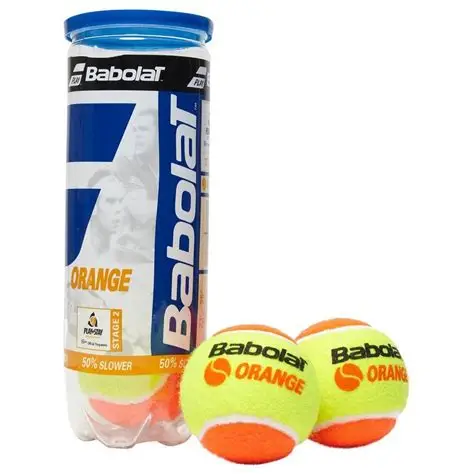
2. Orange Tennis Balls (Stage 2)
Overview
Orange balls are the next step in a child’s tennis development and are used for players between 7 and 10 years old.
Key Characteristics
- Bounce: 50% lower than a yellow ball
- Speed: medium, still easy to control
- Pressure: low pressure
- Court size: 18 m (three-quarter court)
- Racket size: 23–25 inches
Benefits
- More realistic play – Orange balls behave more like real tennis balls but remain manageable.
- Development of footwork – Players must move more, learn recovery steps, and position themselves properly.
- Improved technique – Longer swings, better timing, and preparation.
- Match play ready – Kids can serve, rally, and play full points.
Best For
- Kids transitioning from red balls
- Learning topspin and slice
- Tactical understanding: hitting cross-court, changing direction
- Longer rallies and controlled power shots
Orange balls are the perfect bridge between beginner play and advanced junior tennis.
3. Green Tennis Balls (Stage 1)
Overview
Green balls are used by older children (9–12 years old) or beginners of any age who aren’t ready for yellow balls yet.
Key Characteristics
- Bounce: 25% lower than a yellow ball
- Speed: slightly slower than a normal ball
- Pressure: medium pressure
- Court size: full court
- Racket size: 25–27 inches
Benefits
- Smooth transition to real tennis – Players adapt to full-court movement and realistic trajectories.
- Better timing and consistency – Slower speed allows safer and cleaner swings.
- Confidence in match play – Perfect for tournaments for U10 and U12 players.
- Improved technique with comfort – Great for practicing topspin without losing control.
Best For
- Kids almost ready for yellow balls
- Beginner adults
- Technical lessons and footwork drills
- Match play development
Green balls prepare players for the speed, bounce, and challenges of regular tennis while protecting their technique from bad habits.
Which Ball Should You Choose?
Age and Level Guide
| Age | Level | Recommended Ball |
|---|---|---|
| 4–8 | beginner | Red |
| 7–10 | advanced beginner | Orange |
| 9–12 | intermediate | Green |
| 12+ | advanced | Yellow |
Important Note
It’s not only about age — the coach should choose the ball based on:
- coordination
- strength
- footwork
- confidence
- rallying ability
Sometimes a player may stay longer on red or orange balls, and that is completely normal.
Why Coaches Love Red, Orange, and Green Balls
Professional coaches around the world prefer stage balls because they make learning:
- safer
- more successful
- more motivating
- more fun
Kids smile more, hit more balls, and feel more confident. This keeps them engaged and excited to return to the court.
Modern training methods strongly recommend using red, orange, and green balls even for adults who start tennis for the first time.
Conclusion
Red, orange, and green tennis balls are essential tools for developing young tennis players. They provide the right bounce, speed, and comfort to help beginners learn proper technique, enjoy the game, and progress faster. With these balls, kids develop better timing, cleaner strokes, smarter movement, and a lifelong love of tennis.
If you are a coach, parent, or player, choosing the right stage ball is one of the most important steps in building solid tennis fundamentals and ensuring long-term success.